Tuesday, 25 June 2013

Prehistoric Pottery

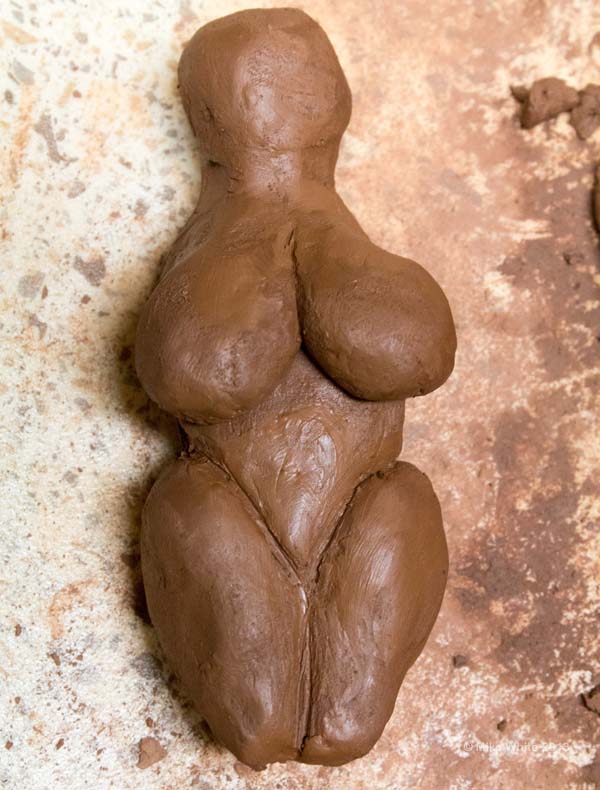
We attended a Prehistoric Pottery workshop at Severn Gorge Countryside Trust.  The photographs I took were partly in preparation for my next OCA assignment, and fitted in well with some of the photographs I took for that (not yet processed/posted).

 We made pinch pots, moulding the clay with our fingers, then added rings or coils of clay to extend them.  Above, a ring of clay is being joined onto the body of the pot.

Here's a pot at a later stage.  The perforations here imitate those of some ancient pots.  Their purpose is not known, but if the pot is filled with lighted grass, air rushes in through the holes and a narrow, hot flame comes out of the top, which could be used for jewellery making.

 A more conventional pot being decorated.  Curiously, there is no representative art on British pots of this period.  There are theories to account for this...  Since pottery is fragile, then its destruction might destroy the 'soul' of the thing depicted?

Pit Firing
Here are some pots that were prepared earlier and dried being fired.  A fire is built in a pit and when there are lots of ashes, a hollow is scraped in the middle for the pots.  The temperature is gradually increased, to drive off the remaining water slowly, to avoid it flashing into steam and blowing the pots apart.  The pots are not covered until they're hot enough for the water to have evaporated.  The test for this is to spit on a pot; if it flashes to steam, the pot's hot enough.

The pots are covered using a lot of bark, which produces ashes, useful as an insulator. 
 
More fuel is added.
 
 The temperature rises to 700 degrees.

The fire has to be refueled to keep it hot for an hour or two, to ensure the pots are fired right through.  If they're not fully fired, the unfired clay will become soft as soon as the pot's wet.
 
 When the fire's been burning for long enough, it's allowed to die down, leaving the pots covered in a layer of ashes to insulate them and allow them to cool slowly.  They must be protected freom thermal shock to stop them cracking.

 
The impatient potter can sneak a look at the pots, but must cover them back up soon, to avoid thermal shock.  The pots are allowed to cool gradually in the ashes, referably overnight.

Of course, you don't just have to make pots.
 

Wednesday, 5 June 2013

Motion Blur

I'd not tried this seriously before.  Isn't it fun!

To get useful amounts of blur requires a longish exposure and movement across the sensor plane.  Movement is less easy to achieve when the subject is approaching or retreating.

Without a tripod - cumbersome and likely to cause an obstruction on the street - a stable horizontal or vertical platform is required.  I decided a table in the window of Shrewsbury coffee house would be ideal, but I had to hurry down Castle Gates to get ahead of these men in high-visibility clothing. Exposure 1/8 second.

I ordered a cappuchino and settled in ambush.
I like this apparently imminent collision outside the Bull's Head.  Shame about the foot of the man on the left, just cropped too much.  Exposure 1/25 second.

That's bettter.  An effect that I hadn't anticipated is that walking involves one leg keeping relatively still while the other moves.  Duh.
Here there are two images of the right leg of this fast walker, and the shadow of a third.
I'm very fond of that wonky window.

This girl texting caught my eye, and luckily a train had just come in to the station down the hill.  Exposures all .6 of a second.
 There's a reflection on the cafe window here, but unless one sees it in more than one shot (as here!), it's not obtrusive.

 Here, cropped, is my favourite. 
The walkers seem to be bustling aggressively up and the window reflection emphasises this, yet the texter calmly ignores them.

I learned a bit about setting up the camera for this work.  I used Live View to lock up the mirror and enable me to see what I was getting, switched to manual focus to reduce delay and movement.  I tried a remote shutter release, but discovered that the motion of the shutter rocked the camera, so I had to hold it down to the table when shooting, so I may as well press the shutter release myself.  Exposures ranged from 1/25 to .6 of a second, achieved with ISO 100 and apertures f22-f29.


Single Figures

I'm finding it difficult to work on this section of the course because there seems no particular point; it's a collection of different things.  However, it's been challlenging to reduce the impact of people, or at least their size in the frame.  I'm thinking more about the use of colour and monochrome, too.

Here, amid the drama of this boat-wash at Brighton Marina, the cause of it all isn't immediately apparent.  If I could have got the shot without the intervening boat parts, I would have done, but I think the clutter in the shot helps show the character of the place better than a perfectly clear one would have.  Colour would add little, black and white helps the drama.

Also in Brighton, this time in the Museum.  Security personnel often stand here and watch.  I like the lampshade and the 'upturned boat' structure of the roof, neither of which command this watcher's interest.  This would work in black and white, but I liked the way the warm colours went together.

Blackwell, in Cumbria, is a beautiful Arts-and-Crafts house, uncluttered by artefacts and paintings as most great houses are.  Most of the surfaces are wood; its warmth and beauty would be lost in monochrome.  I had a great time, exploring and hunting.
 Although it's a big house, it has a homely feel; one could move in and live comfortably here.  This man appears to be taking the cosy welcome too far.
 Corridors run the length of the house on both floors.  They provide places to ambush visitors. 
In these shots I'm trying to show the character of the place but introduce a sense of unease when a second look reveals a fragment of human presence.


A gardener takes a rest at Church Beck, Coniston.  I like the sunlit garden against a dark and threatening sky.  This shot has to be in colour because of the similar tones.

The Print Shop at Yale College, Wrexham, is full of lovely heavy old machinery.  As a visitor, I felt I shouldn't interfere, but now wish I'd shut that cupboard door on the left.
Straightening the perspective on this shot has cropped the leg off the big press.  I need to leave room for it...
Or shoot straight and level in the first place.  Here, the lady eating her lunch in contravention of the rules, is partly obscured.
 

Thursday, 30 May 2013

Showing My Workings

In the study of Mathematics, it's expected that one will show one's workings, to demonstrate the method by which the result was obtained and to allow the validity of that result to be checked.  The photographic equivalent is the contact sheet. 
It's been pointed out to me that my previous post suggested that I'd followed Winogrand and Parr and had deliberately set out to emulate their work.  I was previously aware of their photographs and had already remarked the similarity between their two images and my attraction to them.  In taking my photograph I was certainly informed by this, but its genesis was the seeing of the opportunity, not the setting up of the shot.
Frankie Lynn, burlesque performer and proprietrix of Franki Lynn's Emporium, was using natural light coming through the window to make up the models she'd brought to display the range of clothing and accessories she sells.  I thought there this was opportunity to take some useful shots, though the strong light that was helping Frankie gave me a big range of light levels to cope with.  I decided that I could afford to lose what was going on outside. 
As is my practice, I took a couple of photographs and then requested permission to take more.  I asked the models to carry on with what they were doing.  They were aware of the camera, and in some shots are looking at it.  I decided it would be intrusive if I tried to tidy the table in front, so the handbag, spare lens and water bottle remain.  The lens isn't mine; the owner put it there in the course of my little 'shoot' and it didn't register with me at the time.
Here are some of the photographs I took:
 
Here two of the models are concentrating on the make-up of a third, while the model on the right is checking her own make-up in a very stylised way. 
 
A crop removes the ugly chairs:
But I liked the image mainly because of the model on the right; her focus and self-absorption seem total. I rejected a similar shot because she was obscuring her face with her hand.
Here she is on her own, cropped from the above.
 
The focus changed as Frankie checked another model's make-up:
 Here two models are looking at the camera; the one on the right is consciously posing.  I rejected a similar shot where one model had her eyes shut.  Incidentally, the [160] photographs I took in the day show very low incidence of shut-eye, which I attribute to the confidence of the models and the fact that most of the images were unposed.  However, I didn't like this photograph; with the mixture of posed and unposed, aware and unaware, it doesn't seem balanced. 
 
Here's the photograph I like best.  The burlesque artist Mysti Vine had joined the group, and was talking, apparently to Frankie, though she's distracted, looking off left.
Everyone is animated, yet unconnected with each other.  I like that a lot.
Maybe there's a philosophical point to be made.  It's certainly something to consider when composing my artist's statement!
 
And here it is, with a little more post-production work, to increase contrast and remove distracting lettering from the bottle and the otherwise attractive lamp shade.


Tuesday, 28 May 2013

Garry Winogrand, Martin Parr

Garry Winogrand

There is article in Aesthetica #51, pp58-71 about the San Francisco Museum of Modern Art (SFMOMA) exhibition of photographs by Garry Winogrand.  I was very interested in the photographs reproduced in the magazine; they seemed to be my kind of picture: street, unposed, capturing people doing odd, interesting, revealing things.  One in particular stood out, New York World's Fair 1964, which showed a row of six young women, sitting on a bench.  They're very active and animated, which is attractive in itself, and doing different things. There's a man at each end of the row, providing static, calm, bookends to the excited girls.  There's the sense of an overall story of this group of girls enjoying themselves (though one is crying) together with the individual stories of what's happening to each.  That one of the men is black, and being talked to by a (white) girl, is interesting, given the 1964 date.
http://www.getty.edu/art/gettyguide/artObjectDetails?artobj=53834
I don't intend to visit this exhibition, but I have bought the catalogue.

Martin Parr

I attended a lecture From Late Modernism to Post-Modernism, given by Fergus Reid, lecturer at Shrewsbury School, on 13th April.  Among the Post-Modernists he mentioned Martin Parr.  I remarked on the similarities between the Winogrand above, and Badminton Horse Trials, Gloucestershire, England, from 'The Cost of Living'.  Here again the women are young, active, and doing different things.  They're even book-ended by a serious young man and a person of whom only the drab coat is visible.
http://www.telegraph.co.uk/culture/art/art-features/8723045/The-foibles-of-the-world.html

At Dr Sketchy's

Here's my own photograph, taken at Dr Sketchy's at The Victoria, Birmingham, on 25th May.  The young women are all doing different things, but there's no connection between them.  I liked this; they could be having a conversation, but they're all distracted.  The girl on the right is lost in her thoughts, connecting to no one.  The image is book-ended by the women left and right, who both look towards the centre.
Only a fraction can be seen of the sixth girl, but she's the only one responding to the camera.  I thought that this part-image was a fault, but find that the eye continually returns to her smiling teeth.
The subjects are: Mysti Vine (burlesque artist), Frankie Lynn (burlesque artist and emporium proprietrist), and M/s Lynn's four models.  That's not my 50mm f1.4 lens on the table, BTW.


Sunday, 7 April 2013

Towards Assignment Four

People Interacting With Place: First Thoughts

Here are a few sketches that might be re-shot and turned into photographs.

The Fox, Chetwynd Aston.  The barrell vault of this room has an interesting accoustic property: one can sit in one corner and hear a conversation taking place in the opposite corner, even when there is a noisy group round the centre table.
The figure in the corner isn't noticed at first glance.  In this image its white clothing is completely blown out, but HDR could be used, from a suitable pair of shots, to fix the exposure problem.
Taken with a compact camera; RAW not available.
 
 Rural Space, Pim Hill
An attractive space, here with a single 'accent' figure - and another, top right, on an exercise bicycle!  The rectangular black plates on the exercise machines are removable, and I'd take off the nearest two, though that would expose a large area of floor.  A lower viewpoint.  I like the location of the figure in pink; she's near the vanishing point of all the diagonals, which therefore point at her.  My first thought was to place a figure coming down the stairs, using a long exposure to blur movement and showing only the torso and legs.  But this might be too subtle.  Perhaps a figure leaning over the balcony rail?  I'd like to try all of these.
This image was stitched together from two portrait-format images from a compact camera.  A wider lens on my SLR would probably cover the scene.

Traitor's Gate Brasserie, Shrewsbury
This cellar, with its attractive brick arches, is now under new management.  I see two options: near and far: a figure by the far wall; one sitting at a foreground table.  Or, more subtly, the hand of someone at a nearby table.  With a wine glass?  Framing could be changed, to move the 'tunnel' to the side, and I don't like that hay-basket.

Art Squad, at Shrewsbury Coffee House
This man stands out because his behaviour is different from that of everyone else in shot.  And, of course, he's mugging to camera.  Something more subtle would work: place him right at the back; the only person to respond to the photograph.  His behaviour could be more subtle too.  Simply looking to camera when no one else is.
Another option, to make a person stand out in a crowd would be to use movement blur: either he's the only one still, or he's the only one in movement.  Ranks of soldiers on Horseguards' Parade with a moving figure - has this already been done, with an errant dog?
Does it have to be a live person? A statue among crowds?
Or make the appearance stand out: Erica Roe, the streaker, comes to mind.  Or Spielberg's girl in the red coat, in Schindler's List.

Saturday, 23 March 2013

Assignment 3: Buildings in Use

Assignment Three: Buildings in Use

Minal Church

The church of St John the Baptist in Mildenhall (pronounced Mynal) near Marlborough dates from Saxon times, but by 1816 it was in disrepair and was refurbished, including the installation of its most striking feature, the box pews.
According to a leaflet in the church, Sir John Betjeman referred to St. John's as "a church of a Jane Austen novel", and indeed it was a location used in an ITV film of Emma in 1996.
The pews keep draughts out and bored children in, but their main function was to define territories belonging to the families of the village.  No doubt those who put up the money for the refurbishment were rewarded with the best locations.
It's a very pretty and cosy church, still used for its original function.

St Peter's, Marlborough

St Peter's church enjoys a prime location at one end of Marlborough's broad High Street (markets Wednesday and Saturday) yet the parish church is St Mary the Virgin, hidden behind houses and businesses at the other end of High Street.  It was built in 1460 and various alterations have been made since.
According to a sign in the church, "This former Parish Church became a Chapel of Ease of St Mary's in 1924 when the Parishes were united and St Mary's became the Parish Church. ...reports tell of candles being stolen, a fire being lit, acts of vandalism, and a tramp sleeping under the altar."

Something clearly had to be done.  It was declared redundant in 1974 and leased for a peppercorn rent to a trust, which oversees community use of the building.  The body of the church is now in secular use as a cafe and craft shop.  The cafe seems to be camping in a very large space, but the building is also used as a parish hall for community events.
By contrast, the craft shop is packed into the rear of the church, giving a cluttered appearance.
They are both declared successful, but I can't see how either can be making much money, certainly not enough to support the fabric of the building, which involves separate fund-raising activities.  At least they ensure there are people on site during daylight hours.

The Font. 
There are startling juxtapositions that I'm sure bother some visitors.

The Outer Library, Attingham Park

Attingham was designed in 1782 for Noel Hill, 1st Lord Berwick and is now owned and managed by the National Trust.  The outer library is in the West  wing of the building.  In 2013 its function changed: it is now 'Lady Berwick's Tearoom', providing teas to visitors.
As part of  the conversion, trompe-l'oeil blinds have been installed that conceal and protect the books.  Above them are grisaille paintings by Robert Fagin, on mythological subjects, simulating bas-relief sculptures.  These date from the 1790s and are of high quality.
There's a welcoming fire in the fireplace and two attractive statues oversee the room.
The space was not designed as a tea room and its conversion has presented problems.  From housing thousands of dry books and a few visitors it is now a café serving hot beverages and accommodating (probably) much larger numbers of people.  The books have had to be protected from steam, etc. by the blinds, which are conveniently based on the architect's original design for this room.   But this protection may not be sufficient: the most valuable books have been removed and the fabric of the room will need to be closely monitored. 
Lady Berwick's Tearoom, where visitors can imagine having tea with her ladyship in luxurious surroundings, served by appropriately dressed staff, was previously located upstairs in the house, which meant it was rather hidden away, and visitors had to pay the house entrance fee to use the tearoom.  The present location solves the problems and disabled access is simply difficult, rather than impossible: it's a few steps up to the outer library.  Being on the route most visitors take, it should attract more customers.  The high ceiling and high quality decoration create the luxurious ambience that is expected of Lady Berwick's Tearoom.

The Stables, Attingham Park

Of the same date as the house and outer library, these are now chiefly used as a corridor from the entrance to the bookshop.
The stables are attractive and have been dressed with old-looking lamps.
Generations of horses and their urine have eroded the brick floors and made them uneven and the National Trust is wondering what to do about them for health and safety reasons.
Names are painted on each stall; I think these were the nick-names of horses, rather than those of the stable boys.  The two replaced panels may have been damaged by the horses.
The stables nearer the entrance were of higher status; the finials are more ornate.

 More use is made of the high-status stables.
The horse is the wrong way round, but perhaps he's also fully charged and ready for use.

The Gallery, Attingham Park

Maintenance is always needed on these old houses.  The glazed lantern that provides daylight to the gallery needs attention, hence the forest of scaffolding.  It's very dark and the lighting is red, presumably to protect the remaining paintings.
The lantern can be seen up the builders' ladder.

The gallery stairs are also protected.
Some of the larger paintings have been left behind.
The building work is costing a lot of money.

The gallery is usually a fairly well-lit room; the predominant colour being the green of the carpet.  To see it gloomy red in a forest of scaffolding alters the character entirely.  The route through it is required to provide access to the rest of the house to complete the tour.  But for me it was the place I most wanted to be.

Choices

I've selected two churches, but they are of very different sizes and current use.  I thought it was interesting to contrast them: the little Georgian church; a nut-brown gem in a quiet village, but still fulfilling its original purpose; the large fifteenth century church, redundant and rather uncomfortable in its new use.
I also selected three locations at Attingham Park, choosing rooms with different design functions, uses and states.  It's a place I'm very familiar with.

Technical and Lessons Learned

It's rarely absolutely necessary to use a tripod; in any case their use is prohibited in many locations.  As an aside, I must practise the use of a tripod, though.  The Minal Church photographs were taken by bracing the camera against solid surfaces, as were many of the others.  High ISO was used, especially in the Attingham gallery.  In the stable I braced myself against walls.  I used Photoshop to create two panoramas in Lady Berwick's Tearoom. 
I've learned a number of things about stitching panoramas from this and earlier attempts: keep the camera level; rotate the camera, rather than the photographer, because the latter creates different viewpoints and if Photoshop does manage to stitch them together, strange effects may occur.  This image looks decidely odd: the wall's not straight and the statue's very distorted: