Showing posts with label People and Place. Show all posts

Sunday, 2 March 2014

Assignment 5

The Assignment

This final assignment for my People and Place course was to draw up a brief for a photographic assignment, fulfil it, providing eight to twelve photographs, and provide a short written assessment, to include:
  • The client briefing drawn up.
  • The plan for taking the photographs
  • An assessment of how successful the project was, including any difficulties and unexpected opportunities encountered while carrying it out.

The Brief

I included the brief in a document I supplied to the models I photographed for this assignment: 


Brief

To produce a portfolio of images of writers and artists in their natural habitat for use in magazine/newspaper articles on the creative people of Shropshire.  By ‘natural habitat’ I mean the places where they work, or find inspiration, or which express aspects of themselves and their lives.  The locations and times are to be agreed between model and photographer.

A by-product of this will be to provide the writers and artists with images they may use in their own publicity material.


Photographs

Selected images will be posted on my learning log online and a smaller number of selected prints will be forwarded to the OCA for evaluation.  Each participant may if they wish receive prints and .jpg files of themselves.

I will need to visit participants at places and times to be agreed between each participant and me, and spend time taking photographs.


The Plan


Model Release Form

As a writer and member of Wrekin Writers, I had access to a lot of writers, so it was easy for me to contact a subset of them and ask them to act as models for me.  Writers are sometimes asked by their publishers for publicity photographs, so I hoped the opportunity to get good pictures they could use without restriction would be attractive.   As an additional incentive I'm giving each an A4 print of a photograph they choose.  I gave them a document containing the brief text above, together with a Model Release form.  My intention in issuing a Model Release form was to suggest my seriousness, rather than to collect signed forms.  These people are my friends.  I didn't pursue signatures, but two of my seven models did sign the release.  One model rejected my offer; I didn't press her - many people don't like having their photograph taken.  I think the high level of acceptance reflects my existing relationship with the models. 

The Photo Shoots

I intended to visit each model at their home so that I could see them "in their natural habitat" and also capture "aspects of them and their lives".  I knew that one of my models kept chickens, and planned to picture her with them.  One of my models lives some distance away, but I was able to photograph him in a vacant classroom before the Wrekin Writers' monthly meeting.


The Shoots

I posted details of each shoot, together with a selection of the photographs taken, in my blog, as soon as possible after the shoot.

Technical

Canon 60D, 18-55 mm lens.  For the last shoot I used a new Canon 15-85 mm lens, and was impressed by the improved quality - every pore was visible!
For the first shoot I took a studio flash kit, but didn't even take it out of the car.  It's bulky and would have dominated everything and inhibited movement.  I left it at home thereafter.
I used available light for all shoots, usually daylight, with the shadows softened by the silver side of a circular reflector, which was either held by my assistant or propped up on furniture.  I found that white-painted doors can also make good reflectors.

Assistant

Suki was very useful, because she could talk to the model and also hold the reflector while I took photographs. I'm not good at talking and relating to the model while taking pictures and I was glad of her presence where she was available.  I was able to shoot while the model was chatting to her.  On my own, I felt her absence, though in later shoots my confidence increased.

Shoot Plans

I had a few ideas for each shoot, but where I didn't know the location I had to improvise.  A pre-shoot reconnaissance is valuable. 

Cups of Tea

My confidence increased with each shoot.  I found that accepting the hospitality of a cup of tea was very useful in giving me time to think and plan, but mainly to allow me and the model to relax and talk.  In later shoots my rule became: accept the cup of tea!

The Sun

The movement of the sun provides transient opportunities: in shoot #1 a shaft of sunlight moved and caught the model's face; if I'd anticipated this I'd have taken that shot first, before it became a problem.  Later I had her sit with her back to it and made it illuminate a halo of her hair.  In shoot #2 a shaft came through a skylight and I directed the model so that it bisected her face and provided an interesting image.

Activities: Acting and Doing

In shoot #1 the model played bongos.  When she moved I got blur; when she was still, spontaneity tended to leak away and the pictures looked posed. I managed to get one that was reasonable.  In future, I'd use a bigger ISO or fill-in flash to stop the movement rather than make the model do it.
I asked model #6 to kneel close to her bookcase.  She's no longer young, and it was a hardship for her.  Her discomfort came out in the pictures.

Props and Clothing

Two models asked what colour clothing they should wear.  One brought three options.  I didn't have much of an opinion, provided the clothing didn't wear the model.  It depends on the backgrounds to be used.  Clothing that merges with the background can allow the face to float in space.
#2 wore a bright jumper, which I should have asked her to change for something plainer. However, she also had a lovely hooded cloak, which was splendid.  Her hens proved difficult to catch, but she managed it in the end.
I asked #4 to hold golf balls in a suggestive way.  Not successful.  I got a better picture of him swinging his club in the garden.
Model #7 also came with props.  He's a published author, so I was able to take pictures of him signing and holding his books.  He's also a scientist, so I asked him to write formulae on the whiteboard.  I think the picture of him laughing while doing this is successful.
With him I also discovered that hands can be props too.  There are lots of cheesy professional photographs with the hands in peculiar positions, but they do add variety.
I like the model's face to appear in the photograph and some prop and activitity shots make the face rather small.  I don't think this is appropriate for the current brief.

Equipment and Preparation

Model #3 is a talented and published photographer, so I was anxious about photographing him, though he's a good friend.    He took me for a walk and I hoped to take some pictures in the countryside, since one of the topics on which he writes is the outdoors and walking.   However, I made the rookie mistake of assuming I'd enough battery life on my camera, and neglected to take a spare.  I'd got one in my bag; there was no excuse for not being properly equipped.  I was disappointed with my performance and so was he; he offered me a re-shoot, which I intend to accept.

Background

I'm usually very aware of this; sometimes it's difficult to adjust it while shooting.  More planning would help.  Pictures of #4 at his desk show the garden behind him.  This is distracting-I suspect it distracts him, too!
There's something to be learned about clothing, here.  Something lighter would have prevented #6 merging with the carpet in some pictures, but where the background was light, her dark clothing worked fine.  I'd planned to use reflections off the shiny surface of the piano, but the inverted face looked weird and wasn't flattering.   There's something interesting to be made of this, but not for the current brief.

Variety

All my early shots were from level with the model.  This became very noticeable with #4 and I did manage to get some variation with #5 onwards.

Contact Sheets

I was excited at seeing Tony Ray-Jones's contact sheets so I decided to run off my own. It's a failing of digital photography that there are normally no contact sheets to provide clues to the photographer's thinking. Photoshop can produce these without needing to have the images converted from RAW first. Advantages for me are that I can review pictures in print and in my armchair; I can record my thoughts and decisions, and review them later on. It enables me to capture some of the learning I'm doing.
 

Selected Photographs

Selecting photographs for a brief is different.  Some of the 'best' photographs don't fit the brief well, and have to be rejected.  I interpreted the brief to include writers doing more interesting things than simply sitting writing.  Here's my shortlist:
 

Model #1: Sue

An active, alert photograph; not the one she chose for herself
 A 'bongos' picture, which fits the brief: expressing an aspect of this author.

Model #2: Diane

The 'chicken' picture
Looking mysterious in her cloak. 
 

Model #3: Simon

At his desk, with one of his own landscape photographs displayed
 

Model #4: Angeline

Playing her piano accordion.  Not a great picture, but fits the brief.
 This shows her sense of fun.  It anticipates the laughter that follows.
 

Model #5: Darren

I settled for a simple portrait
 

Model #6: Mollie

Looking winsome: a change of angle
 Playing her grand piano
 

Model #7: Bryan

At the whiteboard
Closeup, looking serious,  with hands.
  

Summary

I was lucky to have such generous and co-operative models.  While one should have some kind of plan for every shoot, it should not restrict what you do; the best shots arise out of the situation and interaction with the model.  Take time.  Even if you hate tea, accept a cup.  It'll provide time to think, look around, and plan.  You don't have to drink it.  This photographer needs to relax as much as the model.
I've one success to report: one of my author photographs is now on the back of a book.

Monday, 16 September 2013

West Dean, Revisited.

My assignment on West Dean was short of pictures of people - this is a course on People and Place, after all.  I've been there again and have taken additional photographs to expand the assignment.

Services

The Lavant river serves as a boundary between the sheep pasture and the grounds.  It's a winterbourne, and dries up in the summer.  As a result, the sheep manage to wriggle through the fence and dine on greener grass.
 And play on the rockery.
Every morning, until an electric fence was erected, farm and gardens staff had to conduct a round-up.
And then return to their normal duties.

Table cloths don't iron themselves. 
Invisible in this picture is the guy under the table holding a tray to iron against.

Artists

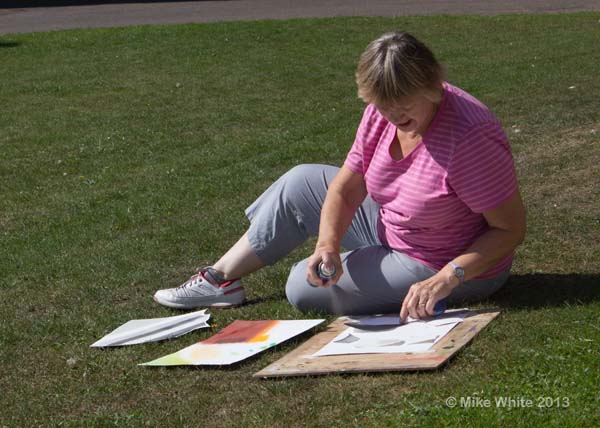
West Dean has beautiful gardens and it would be a shame if they weren't used by students.
This group set off into the garden.
Using collage and mixed media requires...
 ...a lot of materials and equipment.

But it's a lovely location.
 The tutor has to visit...
all the students. 
Wherever...
...they may be.


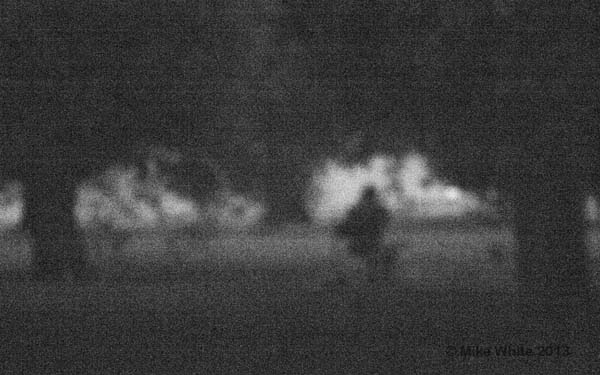
This class even went out at night...
 I hope they could see more than the camera did. [ISO 6400, f5.6, 1/10 sec.]


Wednesday, 11 September 2013

Farley Farm House: Home of the Surrealists.


The Sussex home of Lee Miller, photographer, and Sir Roland Penrose, artist, is open on Sundays for guided tours.  There is a gallery, currently showing an exhibition of Lee Miller’s photographs: “Lee Miller’s War”, and the house is home to many of Penrose’s artworks.
http://www.farleyfarmhouse.co.uk/

Lee Miller was a model for Man Ray and insisted he teach her photography.  She was involved in early work on solarisation.  She took photographs of London in the Blitz and after D-day worked as a war correspondent in Europe, where she was one of the first journalists to enter the concentration camp at Dachau.

Lee Miller’s War

The exhibition of monochrome prints ranges from fashion to the horrors of Dachau.  I select two for comment:

“Gestapo Prisoner, Now Liberated”

http://www.leemiller.co.uk/media/J1ddXe8_UujVXKgDKKvEQQ..a?ts=r05Z-vXElszlYVstIRFtLA..a

This shows an interior with heavy wooden double doors to the outside, defended by a metal grille.  In the foreground, cooking pots and a ladle are in sharp focus.  Behind these, nearer the doors, a woman sits huddled, a heavy coat draped cloak-like over her.  Her hair’s in a scarf, knotted on top.  She holds on her knees two cardboard boxes.  Light falling through the open door silhouettes her face, which is not in focus, yet she can be seen to be staring blankly off, as if remembering.

We are left to imagine the horrors she has experienced, as we imagine the details of her blurred face.  The cooking utensils and other items make this a mundane place, where this victim has been temporarily ‘parked’ while her disposal is determined.  She seems free to leave through the open door, but she does not.  Perhaps she cannot believe it; maybe her declared freedom is just further cruelty.  A powerful image that shows that a message can be conveyed by the subject not being in focus.

The collaborators, women found guilty of Nazi collaboration”

http://www.leemiller.co.uk/media/POZtWCSYrED2SPg3cg5Dhw..a?ts=ZNVB4FiOFp3B3kI4iZDgUA..a

The caption card reads:
Women with shaved heads, Rennes, France, 1944. Women who had had German boyfriends were accused of collaboration by vengeful civilians and had their heads shaved in punishment. Lee Miller wrote; "They were stupid little girls - not intelligent enough to feel ashamed". Later she wrote that she found the process "...both shaming and shameful".

The image is a close view, looking up from chest height, of three shaven-headed young women, looking anxious, with a scornful crowd behind and beside them.  They look like boys; their tonsure has robbed them not just of dignity, but apparently also of gender.  A wedge of sky is delimited by a building in the background and the figure of a man in the foreground.  It points down into the picture at the white blouse worn by one of the women, leading the gaze to circulate round their three pale faces.  They all look towards this man, who is anonymous because his face is in shadow and he’s looking away from the camera, though he seems to block their escape.
 

The House

Many of Roland Penrose's paintings and collages are on display in the house, together with works by Picasso and Man Ray.  It was a thrill to see works hanging on the walls I'd only seen in books before.  He spent a lot of effort promoting the work of other Surrealist artists rather than promoting his own.  I find Penrose's three paintings of Lee Milller: First View, 1947; Pregnant Portrait, 1947; and The Flight of Time, 1949; particularly beautiful.  

Friday, 19 July 2013

Assignment 4: West Dean

A Sense of Place

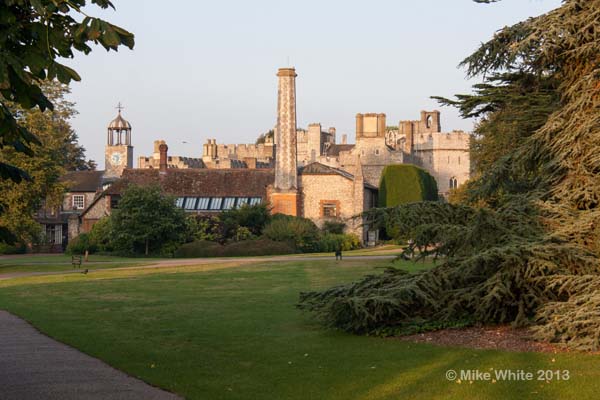
West Dean College

"In 1964, Edward James conveyed his family mansion, art collection and Estate to The Edward James Foundation, a charitable educational trust. The creation of such a trust averted the fragmentation that death duties would have dictated and allowed the materialisation of Edward's vision: creating a community where the Estate supports a college dedicated to the arts and crafts.  crafts. In 1971, Edward James's vision became a reality when the gates of his family Estate were opened under the auspices of West Dean College."
http://www.westdean.org.uk/WestDeanHomepage.aspx

The building is faced in knapped flints and these cause it to shine in sunlight.

This facing material covers the entire exterior of the house.
Rear.

The West wing.

The service buildings and workshops of the East wing.

The enclosed courtyard.

The Setting

 Works of art fill the house and spill out into the surrounding land.


The Lavant river divides the front lawn and house from pasture land.

 The Lavant is a winterbourne, occasionally drying up completely in summer, and an iron fence, hidden in the ha-ha, stops the sheep invading the lawn.

The grounds contain many exotic and interesting trees.  This horse chestnut has never suffered the presence of grazing animals.

Though it has been made into a work of art.
The grounds are open to students and to vistors to the West Dean gardens.

The Studios

The old Orangery is now a workshop:
This group of students is experiencing abstract acrylics.

As part of conversion to an educational establishment, the original building has been extended to provide workshop space.
This roof has been inserted:
Creating a large workshop that can be divided up by partitions:
Individual power sources dangle from the roof.

There are workshops in other parts of the building: Life drawing.
And pottery.
Here, making a pot from slabs of clay is being demonstrated.
While some potters used the wheel, other pots were begun as pinch pots
 and extended by adding coils or rings of clay.
The turntable is an ancient device to enable the potter to produce a symmetrical, round pot without having to move round it.
 
Hanging pre-prepared endpapers for a book-binding course.
 
Abstract in progress.

A finshed piece of work.
 

Services 

An establishment like West Dean has to offer services:
Refectory.
 
Shop for artists' materials.
  
 Maintenance of a big estate like West Dean is a continuing process.
 
"All of the heating and hot water needs of West Dean College (and parts of the village) are met entirely, and on a sustained basis, by using wood fuel grown on the West Dean Estate. The biomass district heating scheme was one of the first, and remains one of the largest of its kind, in the UK." 

Events

It's always a job to make ends meet, and therefore West Dean hosts events through the year.
This group of tipis was used for a most romantic wedding.

 
Most of the events require: 
Tents...
Are erected on the lawn in front of the house.
What a super holly-leaf!
These white tents were erected for the college's recent Fusion festival, intended to raise interest in the work of the college.
Setting up for the Chilli Festival.
Which requires certain essential supplies.
 
Events can involve some of the fun of the fair.
 
But West Dean's primary objective is the teaching of arts and crafts. 

 And it's a beautiful place

Documents


For copyright reasons, photography is not normally permitted in the house.  It contains many art works and curios, including Salvador Dali Kiss sofas and the diver's helmet from which Edward James rescued the surrealist painter.  I applied for permission to photograph in the studios and was issued with a pass.
 
I also produced a Model Release form, which people in the studios completed for me:
 

The Assignment

 I've visited West Dean many times and am familiar with it and the surrounding area.  The plan for the project specified three phases: the building and its setting; the workshops, students and tutors; the other activities, and I have stuck fairly closely to this.  I had a week to complete the photography but found a day's photography very tiring, so I take days off for rest and relaxation.
 
I was fascinated by the potters, who were going to do a Raku firing later in the week and would have liked to spend more time with them.
Though I did manage to take a picture of the outdoor kilns being used.
 
I have visited, but not included: the popular West Dean gardens; the Parish Church of St Andrew, West Dean; the village of West Dean; the substantial West Dean estate; the Goodwood (horse) racecourse, which lies beyond the hills at the front of the house.
 
A few of the photographs above result from earlier visits, and I can see in them how much I have developed as a photgrapher in this course.  There are lots of better things I could have done with those beer barrels!
 
I've learned a lot: a project like this requires not just planning and preparation. It needs discipline and sensitivity to the condition of both photographer and subjects. Both can become tired by the intensity of the process, and need a rest. I have to be careful not to wear out myself, or my welcome. People working together tend to form close groups, and the photographer can become regarded as an intruder, and his presence as oppressive.

I hope that my next project will be informed by all I've learnt so far.