Monday, 27 January 2014

People and Place: Assignment 5, Shoot 1

The Brief

To produce a portfolio of images of writers and artists in their natural habitat for use in magazine/newspaper articles on the creative people of Shropshire.  By ‘natural habitat’ I mean the places where they work, or find inspiration, or which express aspects of themselves and their lives.  The locations and times are to be agreed between model and photographer.

A by-product of this will be to provide the writers and artists with images they may use in their own publicity material.

The Photographs

Selected images will be posted on my learning log online and a smaller number of selected prints will be forwarded to the OCA for evaluation.  Each participant may if they wish receive prints and .jpg files of themselves.

Shoot 1: Sue, writer, 23/01/2014

Kit
18-55 mm lens, reflector.  I took my studio flash outfit but didn't take it out of the car.  It's bulky and would have dominated everything aand inhibited movement.  The reflecor was useful, though white-painted doors worked too.
Assistant
Suki was very useful, because she could talk to the model and also hold the reflector while I tok photographs.  Talking and relating to the model is one of my weaknesses and I was glad of her presence.

Technical

800 ISO; f5.6-7.1, 1/50.  Where there was a big lighting contrast I used manual rather than my usual aperture priority.  In future I'd hope to stop action shots with 6400 ISO or flash.  I took 99 photographs, some of which were for exposure testing.

Images

I was excited at seeing Tony Ray-Jones's contact sheets so I decided to run off my own.  It's a failing of digital photography that there are normally no contact sheets to provide clues to the photographer's thinking.  Photoshop can produce these without needing to have the images converted from RAW first.  Advantages for me are that I can review pictures in print and in my armchair; I can record my thoughts and decisions, and review them later on.  It enables me to capture some of the learning I'm doing.

Location

Sue has a lovely spacious house with a large lawned garden, so there were several locations to choose from.  However I was captivated by the office and most of the images are from there.  There's a large desk with a lovely green leather chair. These items impressed me so much that I rather disregarded Sue's actual workstation: a table behind the door, with a steel and plastic swivel chair. This is more of an administrative workstation than a writer's desk.

Poses

In the office, in the green leather chair, using the reflector to light her face. There was a bookcase in the corner of the room and I was able to get shots with this in the background.
The large desk on the right obtrudes; it wouldn't have been a great hardship for me to step half a pace to the left!
 
This is the one she chose. The presence of the books emphasises that she's a writer.
 
It's very similar to this, which I think is more active but harder, especially in monochrome.

We then moved across the office to her workstation.
The sun was moving round and caught the edge of her face.  If this had occurred to me earlier I'd have taken these shots first, before it got round so far.

We moved her office chair in front of the big green one and turned her round, so that the sun coming in through the high window behind her cast a halo on her hair.
It's a pleasant image, the halo effect on the hair is attractive.

I prefer this, but in colour, the background's a bit busy.

It's less cluttered, and stronger, in monochrome.
I removed the distracting bright lines on top of the radiator.  I think this is my favourite.

We moved to the dining room. This gives onto the garden through French windows, and is where she keeps her musical instruments, including a large pair of bongoes. 
I fell between two stools here. When she played the bongoes there was movement blur and when I asked her to keep still, the spontaneity leaked away and the pictures looked posed. In future, I'd use my biggest ISO or fill-in flash to stop the movement rather than make the model do it.

The garden background tended to overexposure, but I got super modelling on her face, again with the reflector. This was propped up below her while my assistant talked to her.


In general I was able to capture views where the model was not obviously aware of the camera and was animated and well modelled. A couple of to-camera shots. I tried for variety; when using books or garden as part of the picture I felt the figure was too small. Again, I'd ask her to read a book or use her laptop, to get the face illumined from a logical source.

Sunday, 26 January 2014

Taylor Wessing Photographic Portrait Prize 2013

This exhibition is at the National Portrait Gallery, London, until 6th April 2014.  My final assignment for People and Place will comprise a series of portraits, so I was doubly interested.

One recurring theme here is twins.  There's always been something sexy about twins, since long before the Collinsons. There are three photographs of twins here; my favourite was:
The Twins, by Adrian Peacock.
Two elderly women, identical twins, are posed lying on a bed, dressed in bathrobes.  There's no sexual feeling here; they're clearly comfortable with each other - if not with the situation the photographer has put them in.  A display of innocent affection.

Other images that caught my eye:
Jari and Terhi, by Jari Salo
And expectant couple, drug users; she very pregnant and looking at him while he looks to camera.  His eyes are bloodshot; has he been crying?  They face a tough future together, coping with parenthood and battling addiction.
Beauty Recovery Room 01, by J Yeo
A young woman, clad in tights and bra, sits on a bed in a room, looking at the image of herself in a mirror off.  She has a bandage over her head and under her chin, having recently had plastic surgery.  There's a mixture of hope and fear on her face.
Mary Beard, by Adrian Peacock
This woman with controversial opinions (http://en.wikipedia.org/wiki/Mary_Beard_(classicist)) sits on an upright chair with a French window behind.  There are books piled on the table beside her, indicative of her calling.  A sunlit book provides reflective light up onto her face.  The media cruelly said of her, "should be kept away from a camera".  The photographer accepted the implied challenge and has produced a warm, sympathetic, attractive image, avoiding problems like double chin, etc.
Zadie Smith, by Linda Bowler
This writer stares calmy out of a window off left, her hands clasped comfortably together.  A vertical pale line (curtain?) divides the frame into left (model) and right (a blank, dark space).  The composition is interesting, and works.  A different, more conventional, framing would not be as powerful.  Something for me to consider.
Sofia, by Nestor Diaz
The photographer's wife sits right, her crossed legs pointing left.  She has had a mastectomy; the scar has healed.  This picture is partly about colour: the luminous green of the wall behind the orange of her patterned skirt, the light tan of her skin, paler on the surviving breast, darker on the depressed site where the other was.  Her direct gaze is challenging: "This is what I look like.  Get over it."
Vanessa Redgrave, by Christopher Lane
I'm afraid that this seems to be a picture of the still-beautiful woman's sack-like jumper, which dominates the frame.   The shadow of her underwear showing through it helps draw attention away from her face.  If most of it were cropped away, this would become a picture of the woman, not her clothing, and her beauty and strength would be prominent.

I detect two themes in my response to these images. 
The idea of a story, of something about to happen, interests me.  It extends the interest of the photograph into the future.  Without it, a photograph has no time but the instant at which it was taken.  It allows the viewer to contribute to the picture by speculating what is to happen next.
The other one is more commercial.  People usually want to appear their best, and in a formal portrait the photographer is generally expected to try to achieve this.  There's a strong contrast between the photographs of  Mary Beard and Vanessa Redgrave.  In one, the photographer has shown the best of his model.  In the other, he's allowed her beauty to slip away. 

Friday, 24 January 2014

Only in England: Tony Ray-Jones, Martin Parr

"Photography can be a mirror and reflect life as it is, but I also think it is possible to walk, like Alice, through the looking-glass and find another world with the camera." Tony Ray-Jones.

I recommend this super exhibition at the Science Museum's new Media Space.
http://www.sciencemuseum.org.uk/visitmuseum/Plan_your_visit/exhibitions/only_in_england.aspx
It closes on 16th March 2014.

I was attracted to the exhibition by the inclusion of Martin Parr; I hadn't heard of Tony Ray-Jones.   Yet I found I preferred the Ray-Jones images; they show an affection for their subjects, even while sending them up.  He died in 1972, still a young man.

Photographs by Tony Ray-Jones

The first section of the exhibition is of photographs taken and printed by Tony Ray-Jones.  They are small by today's standards: 8" x 6".  I feel this size was suitable for the images, giving a cosy, homely feeling.  I found a recurrent theme in this section: isolation, potential, waiting.  Places that wait, and the people that wait in them.   Spaces that should throng with people but are almost deserted.   The killing of time.  The interminable, dead, time before the expected something happens.  I give examples:
Ballroom, Morecambe, 1968.
A couple dance alone, to the music of an organist and a drummer.  There is room on the stage for a lot more musicians, and space on the floor for many couples.  A white-coated waiter does something to a table.  The dancers are practising, the waiter preparing, and the ballroom is waiting, for the show to begin.
Highland Gathering, Richmond on Thames, 1968.
A field, a tent, a small stage, all set up but no gathering.  Two men, well wrapped up, one in a kilt, sit at a trestle table to sell tickets but no one has come.  They do not even idly watch the piper standing on the stage.
Battersea Park Easter Parade, 1966.
People simply hang about, waiting for the parade to pass by.
Douglas, Isle of Man, 1968.
Two women sprawl in sunshine on steps outside a terraced house.  One sits on the steps, the other lies flat back on a table, hands on abdomen, shins dangling off the end, careless of how she looks.  Bored, they wait...
Dickens Festival, Broadstairs, 1968.
Exterior: a garden.  Two smartly dressed waitresses stand behind a table.  There are no people to wait on: the place is deserted.
Crufts Dog Show, 1966.
A woman reclines, curled in the enclosure intended for her Great Dane, half-hidden by the dog.  They derive comfort from each other's presence, contact, while they wait for something  to happen; for the waiting to be over.

Photographs by Martin Parr

These are from his monochrome phase in the 1970s.  They images don't seeem to me to have the life, the sympathy with subject, the meaning, of those by Tony Ray-Jones.

Photographs by Tony Ray-Jones, printed by Martin Parr

Martin Parr reviewed the contact sheets left by Tony Ray-Jones and printed the photographs in this section.   At 16" x 12", they don't seem to me to have the impact of the smaller images.  There's more waiting:
Margate, 1967.
A mother and two children lean against a wall in a street, their suitcases by their side.

Contact Sheets by Tony Ray-Jones

These covered a wall.  It was exciting and interesting to see the images captured; those selected for printing and those rejected.  It revealed aspects of the way he worked.  Angled and poorly framed images indicate that he often shot from the hip.  A useful ploy, when shooting candid photographs in the street.

Notebook by Tony Ray-Jones

Pages this were displayed on the other side of the wall.  They also provided insight and evidence of the way he worked; the things he thought might be interesting or worthy of attention; the planning that went on.  There's a page of exhortations to himself, titled Approach:
http://mediaspacelondon.tumblr.com/post/52131493534/dont-take-boring-pictures-our-first-exhibition

My Notes

There is more of Tony Ray-Jones's material at the Bradford Museum's Photo Library. I must visit it.
I will incorporate some of what I have learned into my own practice: I shall plan more; I'll prepare more thoroughly; and try not to take boring pictures. 


Thursday, 19 December 2013

Two Photographs: a study.

Cate Blanchett, by Bill Henson for TIME magazine, 2013.

http://au.blouinartinfo.com/news/story/936757/bill-henson-on-his-portrait-of-cate-blanchett-for-time
This image attracted me and I wondered why.  Bill Henson's responses in the article above didn't answer my question, so I studied the image itself.

Composition
A portrait-format rectangle.  The head and the hand are illuminated against a black background.  The line of the truncated neck leads the gaze to the wrist's truncation.  The bend of the hand draws it back towards the face, yet the curled fingers slow the gaze's amovement so that it lingers on the face before travelling around the outline back over the hair to the nape.  The whole forms a kind of inverted teardrop, flying upwards from bottom left towards top right.
Mood
There's a pensive uncertainty to the pose.  The model looks left and down, back towards the past, not right and forwards to the future.  The fingers are raised to the mouth, a common action indicating uncertainty.  Possibly the ancestor of this gesture is finger-or thumb-sucking as a source of comfort.  The eyes are downcast, open but unseeing; the model sees in her mind's eye and does not desire the distraction of seeing something physical.
Pose and Lighting
The photograph is taken with a portrait lens, say 90mm.  There is a single diffused light, high and slightly left.  It illuminates the contours, modelling the nearer half of the face.  The other half is nearly in darkness.  The unlit cheek is just visible and its edge is in line with with the tip of the nose, avoiding over-emphasis of this feature.  A standard three-quarter face then.  The brightest point is the hand; it attracts the gaze and supports the weight of the head.  The index finger could be straight; the top joint can't be seen; it may even be in the mouth.  The other fingers curl progressively; the pinkie almost touches the palm.  There are no catch-lights on the eyes: they would be inappropriate; the model is introspective, not alert.
Model
Cate is beautiful, blonde, smooth-skinned and very slim.  The lighting, mainly on the nearer side of the face, accentuates what flesh covers the skull.  To have lit the distant side of the face instead would have slimmed the nearer side even more.  The hair is a little untidy.  This imperfection is artful: hair as smooth as the complexion would have suggested a statue rather than a human being.   Instead, it indicates humanity and reflects the uncertainty of the subject.  Colour is used here to soften the image.

Harrison Ford, by Michael Birt, May 1999, New York

https://www.google.co.uk/search?q=michael+birt+photographer&tbm=isch&tbo=u&source=univ&sa=X&ei=y_ayUqL2Lcep0AW454GoAQ&ved=0CEoQsAQ&biw=1440&bih=788#facrc=_&imgdii=KscLWaG4vYk8rM%3A%3BYUjmROlkVWc6DM%3BKscLWaG4vYk8rM%3A&imgrc=KscLWaG4vYk8rM%3A%3BGOTr_RpWP1fXGM%3Bhttp%253A%252F%252Fwww.ephotozine.com%252Fimages%252Fexhibitions%252Fnorm%252F1032_1169035329.jpg%3Bhttp%253A%252F%252Fwww.ephotozine.com%252Fexhibition%252Fmichael-birt--portraits-1756%3B300%3B300
A complete contrast; there's no uncertainty or introspection here.

Composition
Square format.  Head and shoulder, closely cropped, losing the top of the head and part of the shoulder.  The model presses against the right-hand edge of the frame, prevented from escaping by the raised forearm, leaving a blank area upper left.  The hands are visible, pressed into the face.  They seem strong.  The shadow along the large vertical muscle at the side of the neck (M. sternocleidomastoideus) emphasises its strength.  The model makes a truncated triangle, a strong, stable shape.  There's tension in the hand supporting the chin.  Everything in the pose and composition is about strength.

Pose and Lighting
A wide-angle lens allows the photographer to get close; the model is in the viewer's space.  The model faces full front and stares at the camera.  The nearest hand is foreshortened, but the ear is very much reduced.  There are two lights; a diffused rectangular box provides most of the illumination, modelling the face, cheek and neck and spilling softly onto the plain background to contrast with the model's black T-shirt.  The right-hand eye is shaded from by the bending fingers of the hand.  Another light, small and direct, provides a catch-light in each eye, especially the shaded one.  The direct, close gaze is challenging; this is someone to be reckoned with.  The impact of monochrome makes this a hard image.

The photographer says, "Ford's obvious physical strength, intelligence and intensity were summoned for a private moment in the studio."  To me, the actor looks fed up.
The World's Top Photographers' Portraits, 2004, Fergus Greer, Rotovision SA, Switzerland.

Study

The photographers clearly put a lot of thought into preparing for these portraits.  I spent a long time looking at just two images; I clearly need to spend at least as much time thinking about the posed photographs I take.

Random Readings

Snowdon

"I like to direct my subjects and tell them exactly what to do.  It is not always a matter of making people feel totally at ease.  Often the only way one can break through someone's prepared face is to make them slightly uncomfortable, physically or mentally.  Sometimes people can be awkard or ill at ease in a way that expresses themselves better than when they are relaxed.  I may, perhaps, ask them to hold a pose for longer than is natural, or I make a remark about the sitter or their work that surprises them, and then watch for their immediate reaction.  On the other hand, I sometimes ask someone to move fractionally, not because I know what I want them to do, but simply because I do not like what I'm seeing and if the person moved I might like it more.  Only when things are going badly do I use the tactic of talking; it is a conscious and artificial device and I only listen to what is said in the hopes that an idea will come out of it; sometimes I leave the sitter alone for a few minutes to change the mood."
Snowdon, 1984. Sittings 1979-1983. Paperback. London. Wiedenfeld & Nicholson

How Fictional are Photographs? by Colin Graham

“Exploring the connection between the literary and the photographic can end up turning on two related paradoxes.”
1.    The notion ‘fiction’ tries to split photography between the real and the fictional.
2.    The photograph is an instant, whereas the literary tells a story that takes place in time.  Yet a photograph can imply a story and writing can describe an instant.  We read photographs in the context of the photographs and stories that have gone before.

A photograph is not the subject, but a trace of the subject.  The trace implies the subject, which existed within time and is the result of some passage of time.  Yet we see the image first then infer the subject so the normal chronology is reversed.  “Photographs … are not the thing they purport to be, and come before the thing they purport to come after.”
 
The article contains sentences complicated by a Roland Barthes-ian parentheticality:
"This doubled narrativity is a useful way to think, askew, of the fictionality of the photograph, so that we ask not if it mirrors reality, or if its chance of reflecting a truth is perverted by the power which produces or distributes the image, but instead we recognise this backwards-unravelling story which is in every photograph, as it appears, now, to show us then."
Graham, C., 2013. How Fictional are Photographs? Source, The Photographic Review, Summer 2013, 75, pp.40-41

Lee Miller on Portraiture

"She dislikes having any friend come along with her clients because, she explains, 'They always give a person and "audience complex", or make him or her wear a "gallery smile", and both are unnatural."
"And a good photograph is just that, to catch a person not when he is aware of it but when he is his natural self."
Article first published in the Poughkeepsie Star, 1/11/1932.

Diane Arbus on Photographs

"They are the proof that something was there and no longer is.  Like a stain.  And the stillness of them is boggling.  You can turn away but when you come back they'll still be there, looking at you."
March 1971.  Probably in "Diane Arbus", 1972, New Yourk, Aperture.

Monday, 16 September 2013

West Dean, Revisited.

My assignment on West Dean was short of pictures of people - this is a course on People and Place, after all.  I've been there again and have taken additional photographs to expand the assignment.

Services

The Lavant river serves as a boundary between the sheep pasture and the grounds.  It's a winterbourne, and dries up in the summer.  As a result, the sheep manage to wriggle through the fence and dine on greener grass.
 And play on the rockery.
Every morning, until an electric fence was erected, farm and gardens staff had to conduct a round-up.
And then return to their normal duties.

Table cloths don't iron themselves. 
Invisible in this picture is the guy under the table holding a tray to iron against.

Artists

West Dean has beautiful gardens and it would be a shame if they weren't used by students.
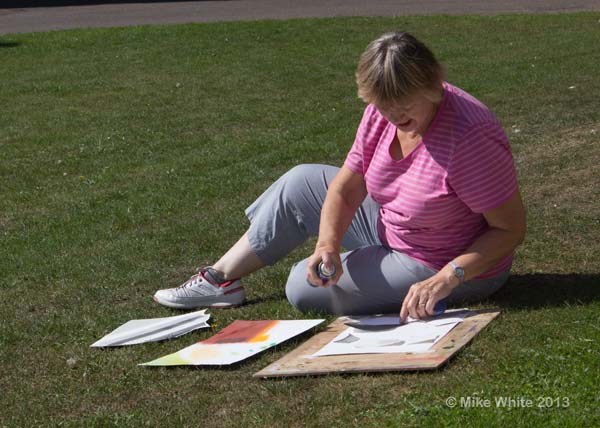
This group set off into the garden.
Using collage and mixed media requires...
 ...a lot of materials and equipment.

But it's a lovely location.
 The tutor has to visit...
all the students. 
Wherever...
...they may be.


This class even went out at night...
 I hope they could see more than the camera did. [ISO 6400, f5.6, 1/10 sec.]


Wednesday, 11 September 2013

Farley Farm House: Home of the Surrealists.


The Sussex home of Lee Miller, photographer, and Sir Roland Penrose, artist, is open on Sundays for guided tours.  There is a gallery, currently showing an exhibition of Lee Miller’s photographs: “Lee Miller’s War”, and the house is home to many of Penrose’s artworks.
http://www.farleyfarmhouse.co.uk/

Lee Miller was a model for Man Ray and insisted he teach her photography.  She was involved in early work on solarisation.  She took photographs of London in the Blitz and after D-day worked as a war correspondent in Europe, where she was one of the first journalists to enter the concentration camp at Dachau.

Lee Miller’s War

The exhibition of monochrome prints ranges from fashion to the horrors of Dachau.  I select two for comment:

“Gestapo Prisoner, Now Liberated”

http://www.leemiller.co.uk/media/J1ddXe8_UujVXKgDKKvEQQ..a?ts=r05Z-vXElszlYVstIRFtLA..a

This shows an interior with heavy wooden double doors to the outside, defended by a metal grille.  In the foreground, cooking pots and a ladle are in sharp focus.  Behind these, nearer the doors, a woman sits huddled, a heavy coat draped cloak-like over her.  Her hair’s in a scarf, knotted on top.  She holds on her knees two cardboard boxes.  Light falling through the open door silhouettes her face, which is not in focus, yet she can be seen to be staring blankly off, as if remembering.

We are left to imagine the horrors she has experienced, as we imagine the details of her blurred face.  The cooking utensils and other items make this a mundane place, where this victim has been temporarily ‘parked’ while her disposal is determined.  She seems free to leave through the open door, but she does not.  Perhaps she cannot believe it; maybe her declared freedom is just further cruelty.  A powerful image that shows that a message can be conveyed by the subject not being in focus.

“The collaborators, women found guilty of Nazi collaboration”

http://www.leemiller.co.uk/media/POZtWCSYrED2SPg3cg5Dhw..a?ts=ZNVB4FiOFp3B3kI4iZDgUA..a

The caption card reads:
Women with shaved heads, Rennes, France, 1944. Women who had had German boyfriends were accused of collaboration by vengeful civilians and had their heads shaved in punishment. Lee Miller wrote; "They were stupid little girls - not intelligent enough to feel ashamed". Later she wrote that she found the process "...both shaming and shameful".

The image is a close view, looking up from chest height, of three shaven-headed young women, looking anxious, with a scornful crowd behind and beside them.  They look like boys; their tonsure has robbed them not just of dignity, but apparently also of gender.  A wedge of sky is delimited by a building in the background and the figure of a man in the foreground.  It points down into the picture at the white blouse worn by one of the women, leading the gaze to circulate round their three pale faces.  They all look towards this man, who is anonymous because his face is in shadow and he’s looking away from the camera, though he seems to block their escape.
 

The House

Many of Roland Penrose's paintings and collages are on display in the house, together with works by Picasso and Man Ray.  It was a thrill to see works hanging on the walls I'd only seen in books before.  He spent a lot of effort promoting the work of other Surrealist artists rather than promoting his own.  I find Penrose's three paintings of Lee Milller: First View, 1947; Pregnant Portrait, 1947; and The Flight of Time, 1949; particularly beautiful.