Saturday, 27 October 2012

Exercise: Telephoto, Wide-angle, Standard

Telephoto

I've posted a lot of my telephoto shots already, but here are a few more:
This cheerful man buttonholed me later and we had a chat.  I didn't understand much of what he said.

These girls weren't chatting - with each other.
 
 This couple looks unhappy: such a contrast from the girl in the sunshine.

 I like the contrast between the hair style in the window and that of the man in the Nikes.  The lean of the ladder and the signpost balance each other.

Wide-Angle

Monochrome seems to suit these.  I'm not comfortable using the wideangle in this way; to get a really good shot you have to be really close to the subject in the corner, invading their personal space, never mind taking their picture.  Maybe I'll try it in a situation where there are more distractions.
 
Ladies on their mobiles. 

These gentlemen were talking here for several minutes.  I nearly cropped the 'Ask' sign out but it seems to add something.

 If you'll just follow the Sleepeezee truck...

Standard

My 18-55 kit lens has a spot at about 27-29 mm which I gather is intended to indicate a 'standard' focal length.  Shooting at this length it's difficult to hide; you're obviously taking their picture, unless you conceal the camera or shoot from the hip.  The following shots were all taken sitting on a bench with the camera in my lap, pressing the shutter with my thumb.  Framing's tricky, and so is keeping the camera level, but these improve with practice.

The pairs of shoppers attracted me.  I've straightened and cropped both of these shots, to centre them in the frame.  I stayed with monochrome for these two because they didn't need colour.

Now they seem to be converging, and have noticed each other.
 
People watching is interesting - and necessary, for a photographer.  A sequence:
This lady applied lipstick...
 
Spent a long time...
 
Smoothing it...
 
Out...
 
Put on...
 
Her spectacles...
 
Met a small child behind a push-chair...
 
Chatted to her and her mother...
 
And watched them go.
 
With the standard focal length, the images feel more intimate than with the other two focal lengths. Telephoto implies and creates distance; one is only an observer.   Curiously, the wide angle seems to me to create a kind of distance, too: one's not an observer but an intruder.  The standard focal length places the photographer in the same space as the actors.  I need to seek a way to use it more often.


Roland Barthes - Camera Lucida

Language

I appreciate that academics write for academics and therefore are obliged to use academic language.  But I'm not obliged to like it.  I came across Barthes in a course book: Photography: A Critical Introduction, (Fourth Edition, edited by Liz Wells, Routledge, Abingdon, 2009), which gave me the impression that he was an even more difficult read than it was.  When I found Camera Lucida (Roland Barthes, translated by Richard Howard, Vintage, London, 2000) I had to take a look.  I found the first chapter quite accessible, so I bought the book.
There's a question with translation: do you translate word for word, phrase for phrase, or do you re-write it in English?  The translator has adopted the former, and I found occasional difficulties where the literal translation reveals a difference between English and French usage: en effet is not exactly the same as in effect; I think unseen vision conveys more than blind field.  I wished my French were good enough to be able to read Barthes' original.  I got used to it, and found that what I'd seen as difficulties were the French coming through: they conveyed the sound and feel of the original language, which added to my pleasure.
Barthes writes in a chatty, rambling style, continually interrupting himself in parentheses and using Latin, Greek and German words where French ones don't convey what he wants to say.  He is primarily concerned with photographs of people.  He's not an easy read, but it's a short book, with short chapters.  I've summarised what I think he says.

Photography and Death

A photograph is always identified by its subject, whereas a painting is always firstly a painting; its subject comes second.  A photograph is always of something that existed.  In this it differs from a painting, for which the subject need not have existed, except in the mind of the painter.  Photographs are redolent of death: a photograph persists after its subject has gone, so even images of people now living foreshadow their death.  'All those young photographers who are at work in the world, determined on the capture of actuality, do not know that they are agents of Death.' (op cit, p.92)

'Whoever looks you straight in the eye is mad'

(op cit, p.113).  People always pose in photographs.  The result is a conflict between 'the one I think I am, the one I want others to think I am, the one the photographer thinks I am, and the one he makes use of to exhibit his art.' (op cit, p13). 

The "Je Ne Sais Quoi"

He wonders why he responds to some photographs and not others, and decides that most photographs are unary; they're only about one thing: the subject, what it's about, which he terms the studium.  He finds these inert.  The ones that interest him have something else to prick him, to touch him.  He calls this the punctum.  'If I like a photograph, if it disturbs me, I linger over it.' (op cit p.99).  Something happens in interesting photographs.   He illustrates this with a photograph: Nicaragua, 1979, by Koen Wessing: http://www.arts.ucsb.edu/faculty/budgett/classes/art19/camlucid_files/image002.gif
where armed soldiers patrol the streets while behind them two nuns cross the road.  This 'co-presence of two discontinuous elements, heterogenous in that they do not belong to the same world' (op cit, p23); the intrusion of normal, peaceful life into a war zone, is the punctum to warfare's studium.
Attempts to insert a punctum by creating a surprise don't impress him.  The punctum can't appear intentional, contrived.  It may be latent, not appearing straight away.  It causes the image to live outside, beyond the occasion of viewing. 
Landscape: he needs to connect with it, not simply observe: 'photographs of landscape (urban or country) must be habitable, not visitable.' (op cit, p.38)
'What I can name cannot really prick me.' (op cit, p51).  If there's an English term meaning punctum, it must be je ne sais quoi.

Bartes' Response to Photographs

He examines his response to a photograph of his mother, taken before his birth, when she was a child.  He finds it difficult to recognise a loved one from a photograph because he knows a lot more than the photograph conveys, but, 'I studied the little girl and at last rediscovered my mother.' (op cit, p.69)
The photograph is tragically limited: it can only show what was seen; not the subject's entirety; not the whole truth.  Yet some photographs express a non-photographic truth; they note not only a characteristic, they are like the subject. They occasionally reveal something about the subject that is not normally perceived.
Seeing a hand-tinted photograph made him feel that however it's created, 'color is a coating applied later on to the original truth of the black-and-white photograph.' (op cit, p.81)
In disagreement with semiologists and sociologists, he's a realist, believing that a photograph is an image without 'code', though accepts that 'certain codes do inflect our reading of it.' (op cit, p.88).
'The Photograph is violent: not because it shows violent things, but because on each occasion it fills the sight by force, and because in it nothing can be refused or transformed' (op cit, p.90)

Mad or Tame?

'Society is concerned to tame the Photograph, to temper the madness which keeps threatening to explode in the face of whoever looks at it.  To do this, it possesses two means.
'The first consists of making Photography into an art, for no art is mad.
'...The other means of taming the Photograph is to generalize, gregarize, banalize it until it is no longer confronted by any image in relation to which it can mark itself, assert its special character, its scandal, its madness.' (op cit, pp.117-118).

Other opinions exist, e.g. http://csmt.uchicago.edu/annotations/barthescamera.htm

I want to take photographs with a punctum, a 'je ne sais quoi' that makes people linger over them.  A landscape may be amazing or beautiful, but without a punctum it does not engage me.

Sunday, 21 October 2012

Exercise: Capturing the Moment: Leontia Flynn

Leontia Flynn, the poet, http://www.leontiaflynn.com/ was reading her work in the Poets and Players event at the Whitworth Gallery, Manchester, and I photographed her, looking for the 'Best Moment'.
Light was limited and at 800 ISO and F5.6 I wasn't always able to stop the movement. I discarded several images in-camera, another twelve on the computer, and here are the rest.
Images 1-4
1) Reflecting; the hand clutches for the next idea.  This is a pause, not a moment.
2) Amused, driving home the point, focussed on the audience.  An attractive view, but I feel the moment has just passed.
3) The punch line.  I like the moving, blurry hand.
4) Earnest, spread fingers, explaining the point.

Images 5-8
5) Quiet; reading the next line.  Preparing for the moment.
6) Voilà, hands outspread.  But she's looking down.
7) Serious point being made, clutched in her fingers.  I like the profile against the background, the modeling of the cheekbone.
8) The moment is over, the chin line unflattering.

Images 9-12
9) Beyond profile, turned away; face too much in shadow.
10) Joky, pulling a face.  Very unflattering.
11) Animated, laying down the law with her hand.  Tip of nose is just beyond cheek line, though.
12) Animated, making point, focussed on audience.  Good modeling of cheeks, neck.

Images 13-15
13) Full length.  In between moments.  Clutter of heads bottom right.
14) Earnest, powerful.  But looking down, framing could be better.
15) Reflective mood.  Chin; eye almost closed.
 
Image 16.  I moved round and took several shots with the day-lit garden background that white balance for the tungsten lighting on the poet has here turned blue.  Here, she seems transfixed: at the point of saying something, feeling something.  It's the moment before the outburst of emotion.  Cartier-Bresson's Behind the Gare St Lazare, not Capa's Death of a Loyalist Soldier.
This is my favourite.  The background's plain, she's alert, clutching the glass to her.  Tense.  The following shots were very animated (and blurred) and their memory influences my feeling towards this image.  It's a still, transitional moment.  Hell is about to break loose.


Exhibitions

8th British International Mini Print Exhibition, University of Wales, Aberystwyth.
http://www.aberystwythartscentre.co.uk/exhibitions/8th-british-international-mini-print-exhibition
Mostly ink and paper prints, but with some digital work. 

Word and Concept, Eve Kask.  Digital Print, positive/negative reflected.  A still life with paper, cut -out text.  In the positive image the shadows aren't noticed, but glow when reflected in negative.  I had to look back at the positive to find them there.  An interesting effect.  The mind expects shadows and so disregards them, but when they glow, it takes note.  Here's my first try at the technique:
She did it much more subtly. 

Au Lever (Awakening), Guy Langevin.  Mezzotint.  Chiaroscuro, only the lower legs of the sitting model emerge from a curtain of dark.  The sharp edge of illumination draws a line across the floor.  The model appears to be putting on stockings.  An image that intrigues and makes the viewer think.  An idea worth trying.

Hair Just Right, Reti Saks http://www.reti.ee/graphic-art/miniprints  Interesting pose, with both hands on one side of the face - and I know just the model!

West Midlands Open 2012 at Wolverhampton Art Gallery 16/10/12
http://www.wolverhamptonart.org.uk/events/west-midlands-open/

A pair of photographs, part of a series, of older women still in posts of authority.  Large: 1m square; colour images, each showing in its centre a mature woman standing in her workplace, facing the camera.  The heritage of such photography goes way back before August Sander’s 1920s People of the 20th Century.  Many others have done the same sort of thing: E O Hoppé’s London Types and, more recently, Hiroh Kikai’s Asakusa Portraits.  But these images did not engage me, being very plain, unary photographs in Barthes’ definition (Roland Barthes, Camera Lucida, 2000, Vintage, London pp40-42.)  Indeed, I even forgot to take down their details.  For me, the most interesting thing was working out how they had been lit: twin flash, high up, so that there were no shadows either side of the subject, yet objects nearer the edges cast diffuse shadows outwards.

Syrian Girl, Anthony Blood, 2012.  Monochrome picture of a girl in a headscarf in a Birmingham square, looking away, out of the frame.  The artist’s statement says that she’s been protesting the government’s non-involvement in the Syrian civil war.  Only the context is important; without it, the picture lacks interest for me.
 
Crossing the Road, Worcester'  David Trippas, 2012.
Colour, street corner, shop to the left, open street centre leading into suburb, at right an articulated truck is parked.  Young people are walking out of frame right, behind the truck.  I repeat here the artist's statement:
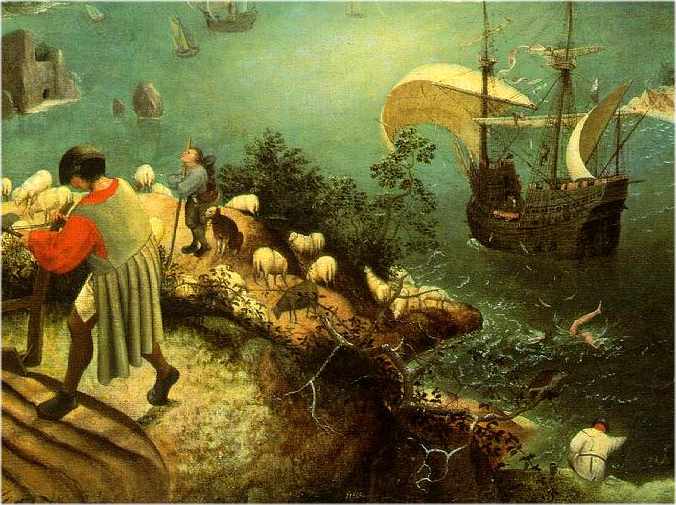
'Reportage with digital, automatic kit is like gunslinging, you make as many decisive moments as you like.  This image has a lot going for it.  The figures are unaware of the camera and seem to be reacting in that one hundredth of a second to the Eddie Stobart truck.  The words on the signs cry normality in a capitalist country and the calm lead-in of the road to a sunny sky has an almost pastoral feeling, contrasting with the life threatening presence of the truck.  It is almost like Peter Breughel's portrayal of "the fall of Icarus".'

The Breughel: http://upload.wikimedia.org/wikipedia/commons/8/84/PBrueghelElderIcarus.jpg
To me, the Breughel depicts pastoral life going on as usual, with the fall of Icarus unnoticed except by the painter.  Trippas' image shows the intrusion of a huge truck into quiet streets, yet it's barely noticed by the people.
What I like most about this image is the statement: 'Reportage with digital, automatic kit is like gunslinging, you make as many decisive moments as you like.' 

 After Vermeer: The Woman with the Pearl Necklace, Simon Francis, 2012.  Approx 18 inches square.
An appropriated image, the Vermeer has been copied, cropped, multiplied and processed, blurring the original image while retaining the composition: the figure of a woman at right; the dark shadow of the window at left; a soft glow fills the centre.  The artist's statement:
'The image has been developed from a Vermeer painting, "The Woman with the Pearl Necklace" using camera movement, long exposure and digital editing.  Vermeer's interiors convey a sense of permanency and an emptiness of space which frame an understated but succinct human action.  My aim was to rid the image of its permanency and representation and then to merge the interior light and its space with the human gesture.  The result is a perception of unbounded movement and transience held in a frame of an unmoving photograph.'

The Vermeer: http://4umi.com/image/art/vermeer/1664_Woman_with_a_pearl_necklace.jpg
The work invites comparison.  Has Francis improved on the Vermeer, or produced something new and different?  I think the character of the image has changed; in the photograph, the necklace is undetectable; the girl could be holding her hands up in fear; the dark shapes on the left may be threatening.  The blurring has left space for the viewer to interpret and create what the picture's about for himself.    The central glow makes me think of JMW Turner's aetherial paintings.  The more I look at it the less I dislike it.  My favourite image from the show.

I was impressed by the artists's statements in the show.  Those above are by no means the most ornate and highfalutin.  If I intend to compete in this company I need to go on a statement-writing course!

Tuesday, 16 October 2012

Defining the Decisive Moment

Henri Cartier-Bresson called his 1952 book Images a la Sauvette, translated as The Decisive Moment, yet according to Wiktionary, a la sauvette means hastily, hurriedly; or on the sly.  Other translations exist.  His Behind the Gare St Lazare 1932:
http://iconicphotos.wordpress.com/2009/04/23/behind-the-gare-st-lazare/
shows the moment before the leaper lands, and hastily describes the photographer's action in capturing the image and I suppose this was the photographer's decisive moment.  The leaper's decisive moment has passed; it was when he leapt; his trousers' moment will arrive when he lands, which would also make an interesting photograph.  The image is cinematic: it depicts a fairly quiet scene, the only action is that of the leaper, about to leave the frame.  The next frame will be full of action. For me, what makes the photograph great is that it involves the viewer, who's allowed to speculate what happens next.

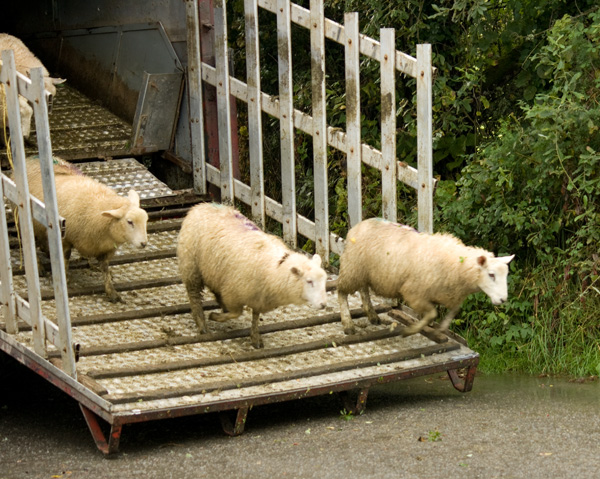
Timing jumps is difficult.  I took a dozen shots of sheep landing before I caught one taking off.  The landing shots were nothing special.  I wonder how many shots Cartier-Bresson took before he was satisfied he'd got the one he wanted; how many pairs of wet trousers were involved.

Robert Capa's famous Death of a Loyalist Soldier 1936 is not about what happens next:
http://upload.wikimedia.org/wikipedia/en/7/7b/Capa,_Death_of_a_Loyalist_Soldier.jpg
It shows the moment the catastrophe occurs.  The viewer wonders how the photographer caught this moment at all; then how he did it without getting shot himself.  Capa was killed years later in Vietnam, so maybe he didn't fake it.  The composition works; the open space in front of the victim is revealed as deadly; his rifle, leaving his grasp and the frame, is cast aside.

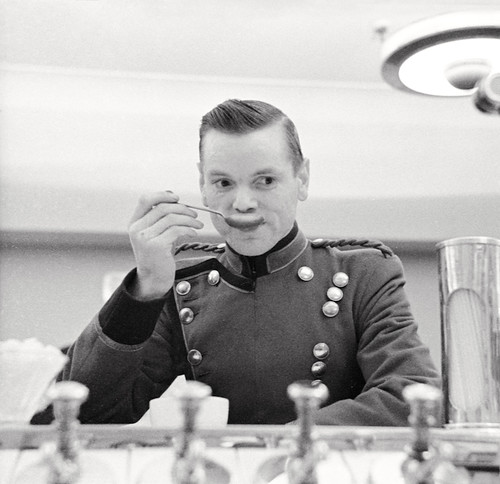
E O Hoppe is a photographer I'm fond of.  One of several photographs titled At the counter in a snack bar, London 1935 shows a uniformed young man holding a spoon to his lips, but looking away to his left, thinking of something else, perhaps remembering.  A moment of contemplation.
http://farm7.static.flickr.com/6214/6311141557_93fc1afb3d.jpg

My spoon-wielder below has his whole body and attention focussed very much on the last mouthful.

And here's a tea-drinker, so engrossed in his book he doesn't even look at the mug.
Resting the camera on the table, I took several on the sly shots of this man drinking tea while reading his Kindle, but here he's just got the mug to his lips.  He'll have to break away from his book to start to drink.  Wonder if he's reading one of mine?

 I like the fact that this biker is holding his spectacles in his teeth while he removes his helmet.  The background branch parallels the handlebars and adds interest to an otherwise plain sky.  The moment of transition between the armoured, helmeted biker and the ordinary man who wants a cup of tea.
 
These girls in Trafalgar Square are very self-aware.  The three Burberry bags help bring them together in a moment of still self-contemplation.
My son had to explain to me that the I-pad can be used as a mirror.

Here's my favourite.  They're having fun, but the body language is interesting.  The posh lady with the cat bag has distanced herself from the others, but compensates by laughing loudest.

And a moment of quiet; these smokers aren't even looking at each other.
Maybe the man on the left is about to say something to break into the other's thought; maybe not.
I like the band of light illuminating the important centre section of the seated man's face.  The diagonal bar of light cuts off the lines of their gaze.  The dark corner of the door delimits it and prevents the viewer's gaze slipping away in that direction.

Friday, 21 September 2012

Unaware on Pride Hill

The brief was to develop confidence and technique by photographing people unaware.  I felt squeamish at spying on them; I'd not like to feel it was happening to me. And concerned at being 'caught in the act' and challenged.
 
First I found myself a good location on a bench looking down Pride Hill, the main pedestrian street in Shrewsbury.  A side street created a sun 'trap' further down, where I could catch people where the light made them stand out from the crowd, though it wasn't always easy to get a clear shot at the right time.

Preparation and Technical
Camera, long lens (55-250mm, mainly used towards the long end), ISO 800, Aperture priority f5.6 to ensure high shutter speed to capture moving targets.  Handy guide to the legal aspects of street photography.  OCA student card and my own business cards, in case of challenge, and to offer subjects the chance to see their photo on this blog.    Never, never, photograph children.

 The process was straightforward.  Select target; prefocus on the road at the intended distance; point, wait, shoot; realign smartly so camera is not pointing at target.  Frequently the target was moving to the side, so it could be allowed to drift out of shot; or lower the camera and brazen it out: don't look at subject.
I grew in confidence.

Some subjects were completely unaware, of course.
 .
Reflections are a problem, shooting through glass...
...sometimes they worked to my advantage. 

Studying people, I saw that some were confident and some needed reasssurance.
Shame about the pushchair.
 
Both these men are waiting, but who for?  I photographed the man with the pipe on the way to my bench, and he was still there an hour later, for this shot.  I don't know how long the other man waited.

The exercise was successful.  I'm more confident now about candid street photography, and when I got stiff and cold on my bench I moved about.  It's a bit like being afraid of spiders: 
It's as difficult for the subject to challenge the photographer
as it is for the photographer to photograph the subject. 

Wednesday, 19 September 2012

Assignment One

Here's my final selection for Assignment 1: six portraits of the same model from six separate sessions, displayed in chronological order: the earliest first. 
This image is taken with two studio flash units plus a small flash behind to illuminate the hair, which hasn't created the complete halo I was looking for.  The backlit hair is out of balance with the rest.  I need to provide my sitter with a mirror, and also to take a more critical look at details before I shoot.  Hard lighting suits the alert expression. 

A more relaxed expression, with softer lighting.  The hand distorts the lip line.

I like the way the hips tilt one way, the shoulders the other.  The model's clearly relaxed and happy.  I should have tidied that strand of hair.  What did I say, to make her laugh?

A rehearsal shot from Suddenly At Home.  The stage lighting has flattened the image and it looks almost as though on-camera flash was used: it wasn't.  Yet there's reasonable modelling, and the distraught expression is clear.  There's a story here: what has upset her so much?

In rehearsal for my play, Katie and Peter.  Better modeling from the stage lights, a happy arrangement of crockery, an interesting pose with cup and saucer, and a quizzical expression.  I could have wished for better framing, but I wanted to crop out the actor on her left.  The story here is in her dubious response to the action to her right.

An image from my latest shoot.  Other images from this session appear in an earlier blog, but I like this pose, the interesting shapes made by the arms, and the drooping fingers.  Looking at this I find my gaze constantly moving from the eyes, down the model's left arm to the hand, where the highlight on the chair bounces it back to the index finger up the other arm to the face and eyes, and so on.  A major objective of a photographer is to get people to look at his photographs, and the longer, the better, and I think this is successful.

My problems.
Technique and technology still intrude in my studio portraiture.  I want to place more of the emphasis on the model, how she looks, how the light plays on her features, how she feels and behaves.  I have difficulty preparing for a shoot; I haven't got a satisfactory notation system to plan with, and poses tend to be ad hoc, and at the suggestion of the model.  With an experienced model this is often okay, but I struggle to direct an inexperienced or nervous one.

What I want to do.
The more I practise, the better I hope to get.  Familiarity with the equipment and situation will help me concentrate on the model and the effects of light.
I'm studying the work of other photographers, trying to understand how they obtained the effects they have, and also deepening my appreciation of portrait photography.
I intend to create a vocabulary of stock poses and lighting situations, documented in photographs, to assist in planning, and as a Plan B, for when imagination fails.
Inside and outside the studio, I want to develop more confidence in directing models and organising the session.  Practice will help here; I just have to get on and do it.

I'm very grateful to Carol, my model in all six sessions.  She's beautiful, confident and relaxed in front of the camera, which make my job much easier.   I hope to photograph her many times in the future, when my skill may perhaps improve until I'm worthy of her.